
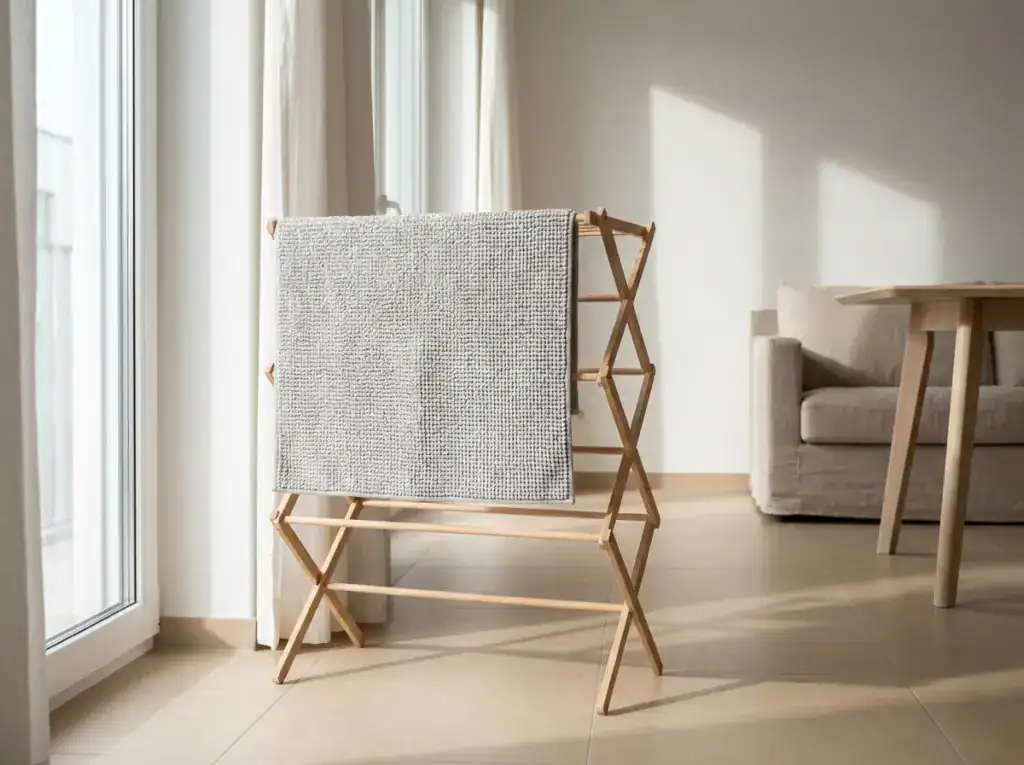
Some bath mats can go in the dryer and some cannot. The answer depends on what the mat is made of, and above all on what its backing is made of. A plain cotton or nylon rug and a chenille mat glued to a rubber base may look alike from the top, but they are very different items once heat is involved.
Here is the short version:
- Read the care label first. If it says “tumble dry low,” use the low heat setting. If it says “line dry,” “dry flat” or “do not tumble dry,” keep the mat out of the dryer.
- Rubber, plastic and foam are a fire safety concern. The U.S. Fire Administration (USFA) states that anything made of plastic, rubber or foam should not be placed in the dryer drum. That covers many rubber-backed mats and memory foam mats.
- Wood, bamboo and diatomite mats are not laundry items. They do not go in a washer or a dryer.
- No label? Air drying is the cautious choice.
The rest of this guide explains each point and how to air dry a mat properly.
Start with the care label
When a bath mat has a care label, it is your most specific guide, because the manufacturer knows what the mat is made of, including the parts you cannot see, such as the adhesive or coating under the pile.
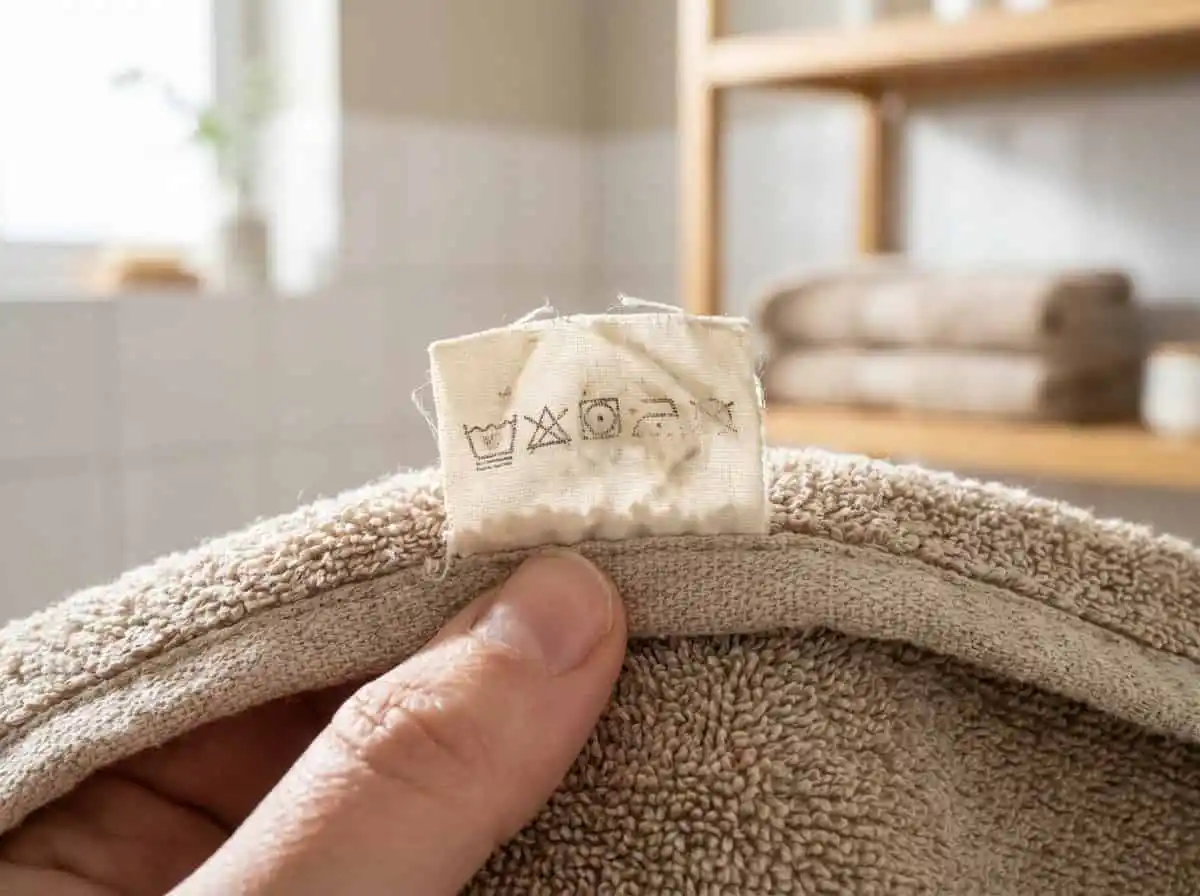
One thing to know: the Federal Trade Commission’s Care Labeling Rule covers clothing (“textile wearing apparel”) and certain fabric sold by the yard. Its definitions do not mention household items such as rugs or bath mats. So a bath mat may or may not have a care label, and the wording can vary from one maker to another.
What the drying instructions mean
The FTC rule includes a glossary of standard care terms. These are the drying terms you are most likely to see:
- Tumble dry: use a machine dryer. When no temperature is given, the FTC glossary says a hot setting may be regularly used.
- Low: set the dryer at low heat.
- No heat: set the dryer to run without heat (an air or air fluff setting).
- Line dry: hang the item damp from a line or bar, indoors or outdoors.
- Dry flat: lay the item out horizontally to dry.
- Remove promptly: take the item out as soon as it is dry.
The FTC also explains that a label does not have to warn against an alternative method. A label that says “dry flat” does not need to add “do not tumble dry,” but the meaning is the same: no dryer.
Reading the symbols
Instead of words, many labels use the care symbols from the ASTM standard, which the FTC allows in place of written instructions. A University of Tennessee Extension guide to these symbols shows how the drying symbols work:
- A square with a circle inside means tumble dry.
- Dots inside the circle set the heat: one dot for low, two for medium, three for high. A filled-in circle means no heat (air only).
- A crossed-out tumble dry symbol means do not tumble dry.
- Separate square symbols (without a circle) stand for line dry, drip dry and dry flat.
Labels made for other markets can use slightly different symbols, so when a label shows both words and symbols, go by the words.
When there is no label
If the label is missing, cut off or unreadable, you cannot know how the backing will react to heat. Air drying the mat is the cautious default. It takes longer, but it does not expose the mat, or your dryer, to a risk you cannot assess.
Rubber, plastic and foam: a fire safety issue
This is where the stakes go beyond the mat itself.
In its report “Clothes Dryer Fires in Residential Buildings” (2007), the U.S. Fire Administration notes that synthetic materials are more combustible than natural materials: they ignite at lower temperatures and burn at much higher temperatures. It states that “anything made of plastic, rubber or foam should not be placed in the drum for drying.” Among its safety recommendations, it lists: never put synthetic materials such as rubber, plastic or foam in the dryer, even if previously washed.
The National Park Service’s fire prevention guidance gives the same advice: do not dry items made of foam, rubber or plastic, all of which can melt and cause a fire.
For bath mats, that applies to:
- mats with a rubber or latex backing,
- mats with a PVC or TPR backing (both are plastics),
- memory foam mats, which are made of foam.
Why some labels still say “tumble dry low”
You may find a latex-backed rug whose label does allow a dryer. A care sheet published by a large U.S. home improvement retailer, for example, lists “tumble dry on low setting” for some latex-backed accent rugs. Manufacturers’ instructions and fire safety guidance do not always line up.
If your mat has a rubber, plastic or foam backing, you have two reasonable options:
- follow the label exactly if it allows the dryer (low heat only, never a higher setting), or
- air dry it, which is in line with the fire safety guidance and avoids the question altogether.
If the label says nothing, or if the backing is already cracked or crumbling, air dry it.
Signs the backing has been damaged
It is worth checking the underside of the mat before each wash. Cracks, flaking, a sticky surface or pieces coming off mean the backing is breaking down. A backing in that condition should not go in the dryer under any setting, and it is usually a sign the mat is near the end of its life.
Cotton, nylon and chenille mats
Fabric mats without a rubber, plastic or foam layer are the most likely to be dryer friendly. Many cotton and nylon bath rugs carry an instruction such as “machine wash separately in cold water” and “tumble dry, low heat.” That exact wording appears, for example, on the same retailer care sheet mentioned above for its cotton and nylon bath rugs.
Chenille mats need one extra check: a chenille top is often attached to a rubber or plastic backing. In that case, the backing decides, not the top fabric, and the section above applies.
If your label allows the dryer:
- Use the setting on the label. If it says low, do not go higher.
- Avoid over-drying. ENERGY STAR notes that dryers with automatic termination (a moisture sensor that detects when the load is dry) prevent wear and tear on fabrics from over-drying. If your dryer has a sensor or “less dry” setting, it can help.
- Remove the mat promptly when the cycle ends.
- Clean the lint filter before or after the load (more on this below).
Wood and bamboo mats
Wood and bamboo bath mats are not textiles and should not go in a washer or a dryer. The USDA Forest Products Laboratory’s Wood Handbook notes that many of the challenges of using wood “arise from changes in moisture content,” which make wood shrink and swell. A hot, tumbling dryer forces that kind of rapid moisture change, on top of the impact.
For routine care, follow the manufacturer’s instructions. In general, these mats are wiped or rinsed rather than soaked, then left to air dry in a spot where air can move around them.
Diatomite (diatomaceous earth) mats
Diatomite mats are rigid boards made from diatomaceous earth, a porous mineral material. They are not fabric, so they do not belong in a washer or a dryer. Care varies by product, so follow the instructions that came with the mat.
One related point is worth knowing. In late 2020 and early 2021, several diatomaceous earth bath mats sold in Japan were recalled after they were found to contain asbestos. Japanese authorities said that solid mats used in the usual way posed no risk of releasing asbestos, but that cutting or breaking them could, and asked owners of the recalled mats to handle them carefully and not throw them away as ordinary trash. Those recalls concerned specific products sold in Japan. If you own a diatomite mat, avoid cutting, breaking or crumbling it, and check its instructions before doing anything abrasive to it.
Memory foam mats
Memory foam mats combine a fabric cover with a foam core. Because the core is foam, the USFA guidance quoted above applies: foam should not go in the dryer. Some memory foam mats have a removable cover; if so, the cover may have its own care instructions. For the foam itself, air dry it unless the label says otherwise, and never use more heat than the label allows.
Keep your dryer safe when you do use it
Every load leaves lint behind, and lint is a key factor in dryer fires.
The USFA reports that clothes dryer fires in the United States account for about 15,600 structure fires, 15 deaths and 400 injuries a year (based on 2002 to 2004 data), and that “failure to clean” is the leading factor contributing to dryer fires in homes. The Consumer Product Safety Commission explains that lint can block the flow of air, cause excessive heat buildup and result in a fire in some dryers.
What the agencies recommend:
- Clean the lint screen before or after every load. This is the advice of both the CPSC and the National Park Service, and ENERGY STAR adds that a clean filter improves air circulation and efficiency.
- Watch for warning signs. The CPSC says that if clothing is still damp at the end of a typical cycle, or drying takes longer than normal, the lint screen or exhaust duct may be blocked.
- Clean the vent and exhaust duct periodically, and check outside that air is coming out while the dryer runs (CPSC).
- Inspect the lint filter for rips and replace it if damaged (USFA).
How to air dry a bath mat
Air drying works for every type of fabric mat, and it is the only option for many of them.
- Shake or gently press out excess water after washing.
- Hang it over a rod, rail or drying rack, or lay it flat if the label says “dry flat.”
- Turn it over partway through, so both sides get air.
- Give it air. The EPA recommends running the bathroom fan or opening a window to reduce moisture in damp rooms.
- Do not drape it on a radiator or next to a heater. The USFA advises keeping anything that can burn at least 3 feet from all heat sources, including radiators, space heaters, fireplaces and wood stoves.
Why drying matters, even without a dryer
The EPA states that “the key to mold control is moisture control,” and that wet items should be dried within 24 to 48 hours to prevent mold growth. A bath mat that stays damp for days is the kind of item that advice is aimed at. Hanging the mat where air circulates, rather than leaving it folded or bunched up on the floor, helps it dry within that window.
Air drying and energy use
Air drying uses no electricity. ENERGY STAR also points out that drying a single towel for 30 minutes costs about as much as drying a full load for the same time. So if you do use the dryer for a fabric mat, drying it with other items that need the same low setting is more efficient than running the mat on its own.
Quick reference by material
- Cotton or nylon, no backing: often “tumble dry low.” Follow the label.
- Chenille or microfiber, no backing: often “tumble dry low.” Follow the label.
- Any fabric with a rubber, latex, PVC or TPR backing: fire safety agencies advise against drying rubber and plastic. Air dry, unless the label specifically allows low heat.
- Memory foam: foam should not go in the dryer. Air dry.
- Wood or bamboo: never in a washer or dryer. Wipe or rinse, then air dry.
- Diatomite: never in a washer or dryer. Follow the product’s instructions and avoid breaking it.
- No label: air dry.
To look at mats by material, you can browse the bath mats category and check each listing’s care information before you choose.
Dryer or not? Three quick cases
1. Your mat has a rubber or PVC backing and no care label.
Not without a label that allows it. The U.S. Fire Administration says anything made of plastic, rubber or foam should not be placed in the dryer drum.
Right. With no label, air drying is the choice that matches fire safety guidance.
2. The label of a cotton mat with no backing says “tumble dry low”.
Right. Follow the label: low heat setting, and clean the lint screen before or after each load.
No. “Low” on the label means the low heat setting, not any setting you choose.
3. You have a bamboo or diatomite mat.
No. Wood, bamboo and diatomite mats never go in a washer or dryer.
Right. Wipe or rinse following the product’s instructions, then let it air dry.
Checklist before you use the dryer
Frequently asked questions
Can you put a rubber-backed bath mat in the dryer?
The U.S. Fire Administration states that anything made of plastic, rubber or foam should not be placed in a dryer drum, and the National Park Service warns that these materials can melt and cause a fire. Some manufacturers’ labels do allow low heat. The cautious approach is to air dry, and never to use more heat than the label allows.
What does “tumble dry low” mean on a bath mat label?
It means you can use a machine dryer at its low heat setting. On a symbol label, it is shown as a square with a circle and one dot inside. A circle with no dots means any heat; a filled-in circle means no heat.
Can you put a memory foam bath mat in the dryer?
The foam core should not go in the dryer, according to the USFA’s guidance on foam. If the mat has a removable cover, check the cover’s own label. Let the foam air dry.
What if my bath mat has no care label?
Air dry it. Without a label, you cannot know whether the backing or any adhesive will tolerate heat.
Can you wash and dry a diatomite or bamboo bath mat in machines?
No. They are not textiles. Follow the manufacturer’s instructions, which generally involve wiping or rinsing and letting them air dry. Avoid cutting or breaking a diatomite mat.
How often should I clean the dryer’s lint screen when drying bath mats?
Before or after every load, as the CPSC and the National Park Service recommend. The USFA identifies failure to clean as the leading factor in residential dryer fires.
- The care label decides. Many fabric mats say “tumble dry low”.
- Rubber, plastic and foam stay out of the dryer, according to fire safety agencies.
- Wood, bamboo and diatomite mats never go in a washer or dryer.
- No label: air dry.
- Clean the lint screen with every load.
Sources
- U.S. Fire Administration (FEMA), Clothes Dryer Fires in Residential Buildings, Topical Fire Research Series vol. 7 issue 1, 2007
- U.S. Consumer Product Safety Commission, Overheated Clothes Dryers Can Cause Fires (Publication 5022), 2012
- National Park Service, Fire Prevention 52: Dryer Fires, 2016
- U.S. Fire Administration, Heating fire safety (prevent home fires: heating)
- Federal Trade Commission, Clothes Captioning: Complying with the Care Labeling Rule
- Federal Trade Commission, Care Labeling of Textile Wearing Apparel and Certain Piece Goods, rule text (16 CFR 423) and Appendix A glossary
- University of Tennessee Agricultural Extension Service, Care Label Symbols (SP519)
- ENERGY STAR (EPA/DOE), Clothes Dryers
- U.S. Environmental Protection Agency, A Brief Guide to Mold, Moisture and Your Home
- USDA Forest Service, Forest Products Laboratory, Wood Handbook chapter: Moisture relations and physical properties of wood, 2010
- Inagi City (Tokyo), Distribution of asbestos-containing products and collection by manufacturers, updated 2021
- Lowe's, Care and Cleaning FAQs (retailer care sheet, weak source used only to show label variation)